
 For the past month I’ve been using 2 different styli, the Wacom Bamboo Stylus pocket and the Sensu, with the goal of finding the best one for sketchnoting on my iPad. I wanted something hardy enough to tote from event to event and comfortable enough for drawing in long stretches. It would be an added plus to find one for creating polished digital paintings.
For my comparisons, I used the styli with Procreate and Paper on an iPad 3. Here’s how they stacked up:
For the past month I’ve been using 2 different styli, the Wacom Bamboo Stylus pocket and the Sensu, with the goal of finding the best one for sketchnoting on my iPad. I wanted something hardy enough to tote from event to event and comfortable enough for drawing in long stretches. It would be an added plus to find one for creating polished digital paintings.
For my comparisons, I used the styli with Procreate and Paper on an iPad 3. Here’s how they stacked up:
Form Factor
Wacom Bamboo Stylus pocket form factor
The Bamboo pocket is touted for its portability. It comes with a removable pen cap that attaches to your iPad via a headphone jack dongle, it can be hung with its pocket clip, and it telescopes from a collapsed length of 3.5″ to an extended length of 4.6″. The stylus end is a rubber nub seen on many other capacitive tablet styli. There is also a black comfort grip.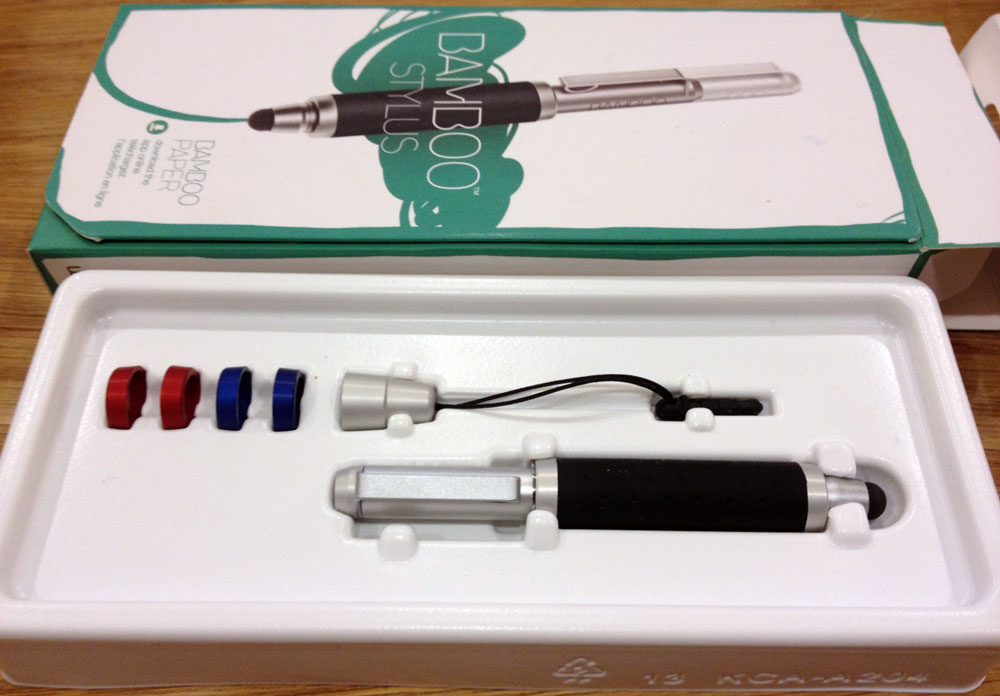 The product packaging is well designed, although it’s a little difficult to extract from its seat. Interestingly it comes with 4 colored rings that can be changed for a personal touch. While this is a nice idea, I can’t imagine there being a strong need to personalize your stylus unless you’re worried it will get lost among a sea of Bamboo pocket users at your next conference.

Bamboo Pocket telescoped to its full length
The Sensu form factor
On the other hand, the Sensu is unassumingly simple. The packaging is no fuss—it arrives in a foam sleeve inside a box smaller than the Pocket’s box—and there are no additional accessories. It looks a little like a silver bullet. On one end it has a rubber nub similar to the one on the Bamboo pocket, and on the other end there is an artist’s brush with capacitive bristles. When transporting the Sensu, the rubber nub end serves as a cap for the brush end. In its capped state it serves as a simple 4.5″ stylus. To use the brush end, uncap it and slide the rubber nub end into the brush end to create a longer handle (full length is about 7″). After constantly capping and uncapping it for a month, I can say there has been no damage to the metal shell.

Sensu with the brush end capped

Sensu with the brush end exposed
Drawing
The nice thing about most iPad styli is that there is no setup time required; just pull out the stylus and start drawing. That said, there are definitely differences in experience between the Bamboo Pocket and the Sensu.Drawing with the Bamboo pocket
 The tip of the Bamboo pocket is a rubber nub, which is a typical element on several iPad styli. It’s cheap, highly durable, and maximizes the touch area for initiating a stroke. On the Bamboo pocket it is roughly the size of a pencil eraser, and after use of over a month I have not experienced any wearing down.
I find drawing with the Bamboo pocket unwieldy. The rubber nub occludes the drawing underneath and I can’t always tell if lines are registering. I also have to exert quite a bit of pressure to make a stroke. I end up spending a lot of time dragging and driving the Pocket around the screen, leading to fatigue and inconsistent or broken stroke lines. This is compounded by the short length of the stylus which makes it harder to hold.
That said, it is pretty handy for drawing text, dots, or small areas of detail. I wouldn’t use the Pocket for expansive sketches or fills.
This is a video of me drawing with a Bamboo Pocket.
The tip of the Bamboo pocket is a rubber nub, which is a typical element on several iPad styli. It’s cheap, highly durable, and maximizes the touch area for initiating a stroke. On the Bamboo pocket it is roughly the size of a pencil eraser, and after use of over a month I have not experienced any wearing down.
I find drawing with the Bamboo pocket unwieldy. The rubber nub occludes the drawing underneath and I can’t always tell if lines are registering. I also have to exert quite a bit of pressure to make a stroke. I end up spending a lot of time dragging and driving the Pocket around the screen, leading to fatigue and inconsistent or broken stroke lines. This is compounded by the short length of the stylus which makes it harder to hold.
That said, it is pretty handy for drawing text, dots, or small areas of detail. I wouldn’t use the Pocket for expansive sketches or fills.
This is a video of me drawing with a Bamboo Pocket.
Drawing with the Sensu
 The Sensu has two tip options; a rubber nub and a brush tip.
Since the rubber nub tip of the Sensu is almost exactly the same as that on the Bamboo pocket, my drawing experience with it is unfortunately the same: It requires a lot of pressure, creates inconsistent or broken strokes, and is inefficient for large areas or fills.
In stark contrast, drawing with the brush side of the Sensu is a dream. The bristles are capacitive, so it requires little to no pressure to exact a line. You instead use light, sweeping strokes to paint or sketch. This, paired with the more comfortable length of the Sensu, make it feel like a natural artist’s tool (especially for anyone who longs for that feeling of a ball point pen gliding across sketchbook paper).
The Sensu has two tip options; a rubber nub and a brush tip.
Since the rubber nub tip of the Sensu is almost exactly the same as that on the Bamboo pocket, my drawing experience with it is unfortunately the same: It requires a lot of pressure, creates inconsistent or broken strokes, and is inefficient for large areas or fills.
In stark contrast, drawing with the brush side of the Sensu is a dream. The bristles are capacitive, so it requires little to no pressure to exact a line. You instead use light, sweeping strokes to paint or sketch. This, paired with the more comfortable length of the Sensu, make it feel like a natural artist’s tool (especially for anyone who longs for that feeling of a ball point pen gliding across sketchbook paper).

Sensu bristles are still holding up strong after continued use